bilibili
China’s ancient oracle bones reveal earliest written record of meteor shower 3,000 years ago_我的网站

一 |

This photo taken on Nov. 18, 2025 shows the Leonid meteor shower seen in Heihe City, northeast China's Heilongjiang Province. (Photo by Qian Boyu/Xinhua)Chinese archaeologists have pieced together ancient oracle bone fragments to decipher what they say is the earliest written record of a meteor shower, dating back more than 3,000 years and shedding light on astronomical observation in the Shang Dynasty (c.1600BC-1046BC), roughly the Late Bronze Age in the West in which Homer's
Odyssey was rooted.
The inscription, found among more than 80,000 fragments, consists of three characters that read "star", "all" and "west," describing a large number of meteors streaking across the night sky and falling westward like rain, Huang Tianshu, a professor at Tsinghua University's Research and Conservation Center for Unearthed Texts, told the Global Times.
"The first character is 'star'… the second means 'all' or 'in batches', depicting meteors falling in large numbers like rain, and the third is 'west,' used as a verb to mean falling westward after crossing the sky," Huang said. "This is important astronomical data recording a meteor shower more than 3,000 years ago."
The team spent years rejoining shattered oracle bones, a process of piecing fragments back together, and only after reassembly did the meaning become clear.
"Before rejoining, you have no idea what it is saying. Once rejoined, the content becomes largely intact and turns into a very important piece of material for studying history or language," Huang added.
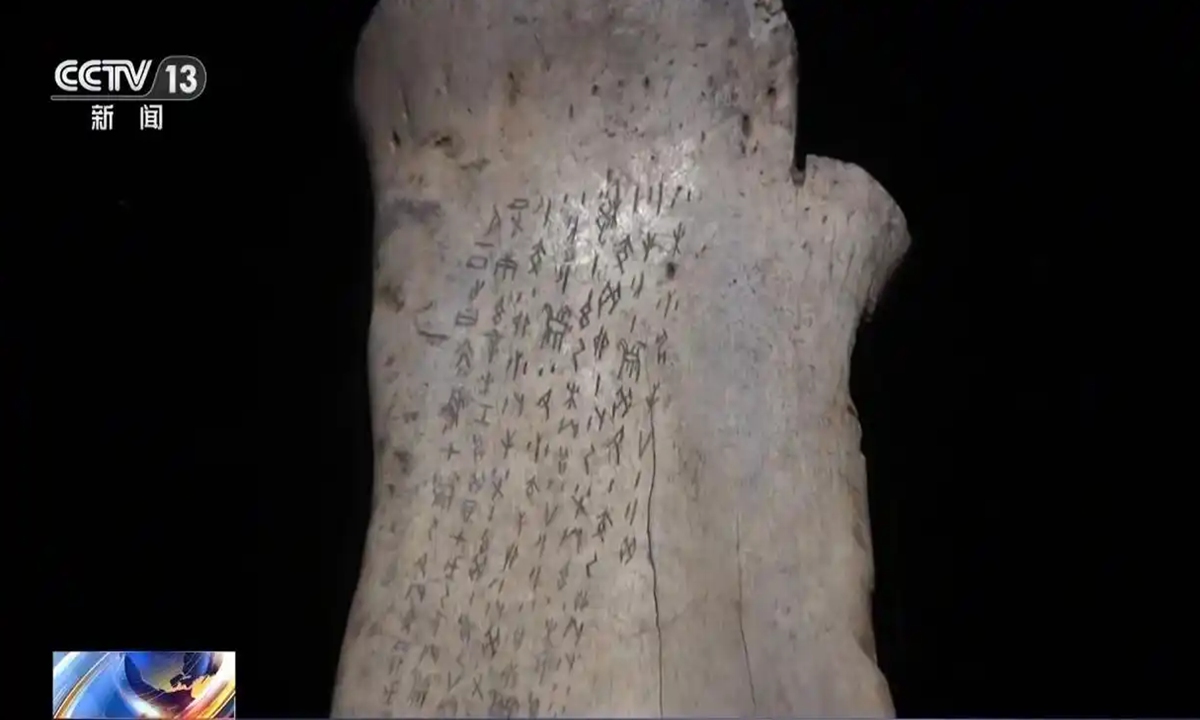
One piece of ancient Chinese oracle bone Photo: CCTVHuang Dekuan, head of the expert committee for China's national ancient script project, told the Global Times on Tuesday that the record is "the earliest meteor shower documented in Chinese writing," adding that it was a representative achievement that would enable oracle bone inscriptions to be better used as scientific historical sources and push oracle bone studies to a new level.
The discovery is part of a decade long effort that has newly rejoined more than 1,200 groups of fragments, with the results published in a major compendium of oracle bone facsimiles. The research was part of a state-backed project on inheritance and studies of ancient Chinese scripts and civilization, CCTV reported.
The first phase of the national project is about to complete, yielding a string of major findings. These findings provide vital new materials for studying early Chinese civilization and demonstrate the significant value of ancient Chinese characters in the development of Chinese and even human civilizations, per CCTV.
。 There are movies you watch and then there are movies you grow up with. Kabhi Khushi Kabhie Gham, or simply K3G, belongs in the latter category. The movie was released in 2001 and became one unapologetically grand Bollywood family drama by all means. Needless to mention, by all modern logic, it may feel dated to today’s Gen Z audience. And yet, more than two decades later, it remains a cultural mainstay. It is still memed, streamed, quoted and rewatched with the same enthusiasm as ever. Surely, you scroll through a bunch of Poo-inspired memes every day, and so do I!So, what is it about K3G that continues to resonate with a generation raised on Instagram reels, global cinema and an 'it's simply not giving' attitude?The drama is the point
First things first: K3G does not do subtle and that’s exactly why it works. In an era of overstimulation and performative minimalism (cue in clean girl aesthetic), K3G offers catharsis through excess. The emotions are loud, the conflicts are operatic, and the stakes are always sky-high. Estrangement from your family because you married for love? Of course. Tears flowing in designer sarees? Naturally.Gen Z doesn’t love K3G despite its melodrama, they love it because of it. The film understands that feelings don’t come in half-measures and neither does Bollywood at its most iconic.Characters that became archetypes
Few films have characters as instantly recognisable as K3G. Rahul Raichand (Shah Rukh Khan, who else?), the turtleneck hot cake is the blueprint for the emotionally wounded romantic hero. Anjali, played by Kajol, is chaotic, loud, loving and relatable with a capital R. Poo (Kareena Kapoor Khan), once dismissed as over-the-top, is now a certified Gen Z icon. Why? She is confident, self-aware, and living by her own rules long before 'main character energy' was a thing. These characters have transcended the film itself. They are in GIFs, memes, audio trends and Halloween costumes. Most of Bollywood's digital footprint, thanks to Karan Johar, is filled with K3G.Nostalgia without the baggageMillennials would agree, K3G is nostalgia tied to childhood. It was a part of Sunday television reruns in family living rooms. But for the Gen Z, the nostalgia is second hand. But no less powerful. It is comfort cinema without personal baggage. Watching K3G feels like stepping into a warm and exaggerated version of a family. The said family is flawed, dramatic but ultimately united. Interestingly, K3G offers a fantasy version of reconciliation. It does not pretend to be realistic but promises emotional closure. And sometimes, that’s exactly what viewers want.Aesthetic excess, before it was cool
Let’s talk about the look of K3G. The mansions (how can the Raichand house be in Delhi?), the couture, the sweeping foreign locations, the slow-motion entrances and more kept the cinematic maximalism alive, before TikTok rediscovered it. Gen Z, with their love for irony and camp, understands K3G as both sincere and spectacular.
There’s a reason scenes from the film circulate endlessly online. Jaya Bachchan sensing Rahul’s presence and Poo declaring her life philosophy lends itself effortlessly to remix culture. K3G knows it is iconic and does not have to fight for a place in the museum of the grandest Bollywood movies ever made.Music that refuses to ageFew Bollywood albums have the staying power of K3G. Kabhi Khushi Kabhie Gham's aching title track in the legendary Lata Mangeshkar's voice to the wedding staple Bole Chudiyan continue to show up at family functions, reels and late-night nostalgia playlists. For Gen Z listeners, these songs carry drama and longing in just a few notes. The tracks don't need the algorithm to drive them to the right audiences, for they are popular just the way they are.The comfort film effect
At its core, K3G survives because it understands that people return to stories that make them feel held. The film doesn’t judge its characters for wanting love. It validates those desires with dhol and background violins.Gen Z, often labelled detached or ironic, has shown time and again that they crave sincerity. K3G delivers sincerity in abundance. It says it’s okay to care too much, cry openly (men, take notes) and believe in dramatic reunions.Also Read: Kajol Celebrates 24 Years of Kabhi Khushi Kabhie Gham With Fun Post。

二 |
Current article:http://nk7we4c.zanjionglangzhaizhizaxiying.buzz/gjm2/20260826/834877.html
Published on:13:44:50


